Gray whale
The TrenchGray whales appear in the novel both as a migrating population and, most closely, as Tootie, a rescued calf whose return to the wild becomes an unresolved test of human care. Her recovery is measured in pounds, feeding, and the fitting of radio transmitters; her life after release is shaped by migration, local food, and the danger posed by the Megalodon. A separate encounter with a pod shows the whales not as passive scenery but as animals whose collective movement can abruptly change the risks facing people nearby.
Tootie’s Rescue and Recovery
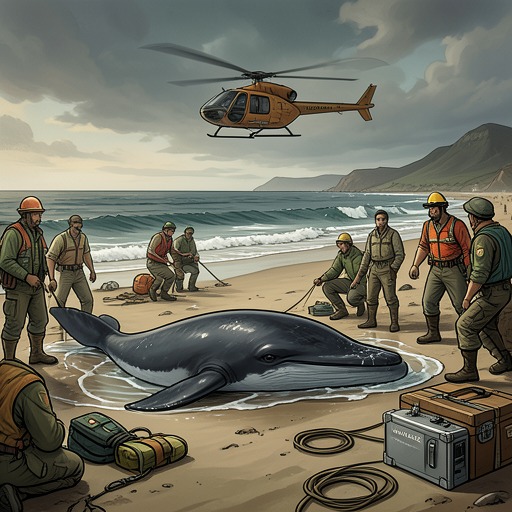
Tootie enters the story as a gray whale calf under Sea World’s care. When she arrived, she weighed about 1,500 pounds and was comatose. Animal-care specialists revived her, and within days she was eating again. Her subsequent gain—about two pounds a day—turns recovery into a visible, sustained process rather than a single moment of rescue. By the time zoologist Andrew Furman begins attaching radio transmitters, Tootie weighs 19,000 pounds and measures 31 feet long. Sea World’s estimate is that, when fully grown, she should approach 60,000 pounds.
Those figures establish both how far she has come and how much growth remains ahead of her. The calf is large enough to be considered ready for release, but she is not yet full-grown or independent of the challenges facing a young whale in the wild. Her care therefore moves from revival and feeding toward a different kind of human involvement: tracking her without keeping her in captivity. Two remote radio transmitters are attached so her movements can be followed over the next several months.
Release and Migration
Sea World chooses the release timing in relation to the gray whales’ seasonal migration. Thousands are expected to travel north along the Pacific coast toward summer feeding grounds in the Bering Sea. Releasing Tootie during that movement is intended to give her an opportunity to join a pod, where she may continue learning to feed and avoid killer whales. The plan depends on her being strong enough to leave care and on the migration offering a chance to travel with other whales; the transmitters make that attempt observable after release.
The later reports complicate that hopeful plan. Tootie is described as having abandoned her effort to migrate north and as feeding in Grays Harbor, where whale watchers spot her. A report gives her weight as 18,000 pounds, compared with the earlier figure of 19,000, and identifies her as a newborn calf that had stranded along OceanShores four months earlier. The difference in reported weight does not resolve her condition, but the reports agree on the significant change in her route: rather than continuing toward the Bering Sea, she is feeding in the harbor.
Feeding and the Whale Pod
The novel gives gray whale feeding a practical, repeated rhythm. In Grays Harbor, Tootie works along the muddy bottom, taking in turbid water and filtering sandhoppers and other bottom-living organisms from the silt through her baleen. After several minutes she rises to the surface to breathe, then submerges and feeds again. In another scene, she scoops up kelp at the surface and uses her baleen to strain the small sea creatures attached to its leaves. These passages show different feeding settings while keeping attention on the same sequence of intake, filtering, swallowing, and renewed submersion.
A separate pod is observed feeding near phytoplankton blooms. Karen explains that the blooms support small larvae and fish, which in turn attract baleen whales. The group of grays consists of five or six adults and a calf, seen from kayaks that have approached to within fifty feet. The scene places the whales within a food chain and a seasonal gathering, rather than presenting their arrival as an isolated spectacle. It also establishes the pod’s close formation before that calm observation gives way to sudden movement.
Proximity to the Megalodon
Tootie’s location becomes a source of urgent concern when fishermen report the escaped Megalodon off Leadbetter Point. The animal had attacked a Coast Guard vessel, killing two people, and was said to have followed a fishing boat into the bay before heading back out to sea. Meanwhile, Sea World’s tracking information places Tootie less than 25 miles from the predator’s last reported location. The radio transmitters, introduced as a way to monitor the calf’s return to the wild, now make her location part of an immediate assessment of danger.
The news report prompts criticism that Sea World should have delayed the release until after the Megalodon was recaptured. Pete Soderblom objects that Tootie was released at least a week before the shark escaped, a detail the report omitted. That disagreement exposes a limit of the rescue plan: careful timing around migration could not account for a predator that had not yet escaped. Andrew Furman reports that Jonas Taylor, tracking the Megalodon aboard the William Beebe, believes it could reach Grays Harbor within three hours. The account raises the prospect that the shark could enter the bay and threaten Tootie, but the supplied scenes do not confirm what ultimately happens to her.
Collective Movement and Narrative Significance
The encounter with the kayakers gives the gray whale pod a different kind of presence. When the grays stop feeding, Karen recognizes that something is disturbing them and sees them close ranks. The pod then moves together toward the kayakers. The whales sound just before reaching the boats, whose movement becomes unstable in the resulting swells; afterward, the sea calms and the whales are no longer visible. The scene does not explain the disturbance with certainty, but its sequence links the whales’ changing behavior to an unseen presence beneath them and turns observation into danger for the people watching.
Together, Tootie and the pod place animal life beyond the control of the human characters who study, rescue, track, or observe it. Tootie’s transmitters supply information, not protection; the migration plan offers a possibility, not a guarantee. The pod’s movement likewise refuses to remain a predictable display for the kayakers. Gray whales thus connect the novel’s intimate account of one calf’s recovery to a larger world of migration, feeding, and risk, where human attention can register what is happening without determining its outcome.